What GEO means
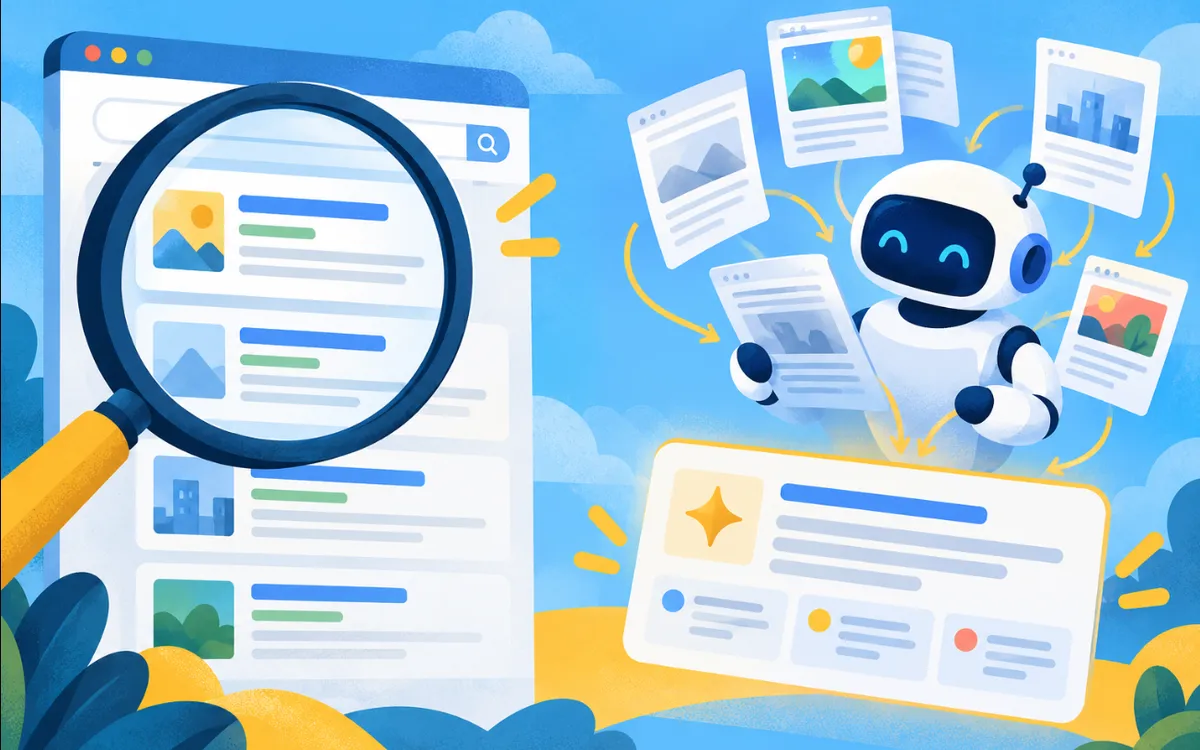
GEO stands for “Generative Engine Optimization”. A generative engine is a service that writes an answer with AI instead of just listing links: ChatGPT with search, Google’s AI answers, Perplexity and similar.
It is a term popularised by the industry, not an official discipline. Google, for example, does not talk about GEO: it describes AI Overviews and AI Mode as Search features that build an answer and show links to pages that support it.
That is why GEO is best understood with some humility: it is a way of naming the work of making your information easy to read, verify and cite for systems that summarise the web.
SEO and GEO: what they share and where they differ
Google states that its generative AI features are based on its core ranking and quality systems, and that no special optimisations are needed to appear in them. In practice, SEO remains the foundation.
| SEO | GEO | |
|---|---|---|
| Goal | Your page appears well placed in the results | Your business or page is used as a source in an AI answer |
| Visible result | A list of links | A written answer, with or without links to sources |
| Technical basis | A crawlable, indexable, fast and clear site | The same, plus permission for each assistant’s crawlers |
| What you work on | Search intent, content, links, experience | Direct answers, business entity, consistent and verifiable details |
The difference in approach is subtle but real: an AI answer often combines several sources, so it is not enough to have one well-ranked page; each page needs to say something clear, checkable and easy to attribute.

What the work involves in practice
Access: crawlers can read your website. Each assistant has its own (OAI-SearchBot for ChatGPT, PerplexityBot for Perplexity, Googlebot for Google) and they are controlled in robots.txt.
Clarity about the business: who you are, what you offer, to whom and where, written identically on your website, your Google listing and your profiles.
Content that answers: pages that respond to real questions with a direct answer at the top and verifiable facts.
Consistent details: opening hours, area, services and contact details with no contradictions between sites.
Honest measurement: seeing which visits come from assistants and how you appear, knowing that answers vary.
If you already do SEO, you are ahead
Do not start from scratch. A well-crawled website with useful pages and clear details already covers most of it. What is specific to GEO is checking AI crawler access and writing to be cited.

Common myths
- “There is special markup for AI”: Google says no special schema.org markup or new files are needed to appear in its AI features.
- “You have to chop your text into pieces for AI”: Google says there is no need to break content into tiny chunks.
- “Write differently for robots”: Google recommends writing for people; no specific style is needed for AI search.
- “A tool tells me my exact position”: Google makes clear that no third-party tool has access to its internal ranking or AI systems.
That does not mean there is no useful work, only that the useful work is the usual: quality content and a technically healthy website. If ChatGPT is what interests you, the steps are in how to get your business to appear in ChatGPT.
What GEO cannot promise
An AI answer depends on the question, the sources available and the model itself. Neither OpenAI, Google nor Perplexity offers a way to buy or secure a mention. Anyone who guarantees you will appear is promising something they do not control.
The sensible approach is to improve eligibility: let them read you, explain yourself well and keep reliable details. That is the line of work of our GEO and AI visibility service, always without guaranteeing results.
Frequently asked questions
Does GEO replace SEO?
No. Google’s AI features start from its normal ranking systems, and assistants that search the web need crawlable, useful pages. GEO adds care for AI crawlers and for how your information is cited, but it does not replace the SEO foundation.
Do I need a special file for AI?
No. Google states you do not need to create AI text files, special markup or Markdown to appear in Search. The llms.txt proposal exists, but Google says it ignores it. You will find the detail in what llms.txt is.
Can I stop AI from using my content?
In part. You can block specific crawlers in robots.txt, such as GPTBot for OpenAI training, and use Google-Extended for Gemini training and grounding. Each control is independent and affects different things, so decide which one you want before blocking.
Is it worth getting mentions on other websites?
Genuine mentions, which arrive because your work is good, help you become known. Google warns, however, that chasing inauthentic mentions around the web is not as useful as it seems. It is better to build a real reputation than to manufacture signals.
Sources4
- Google Search Central — Optimizing for generative AI features on Google Searchdevelopers.google.com (opens in a new tab)
- Google Search Central — AI features and your websitedevelopers.google.com (opens in a new tab)
- OpenAI — Overview of OpenAI crawlersdevelopers.openai.com (opens in a new tab)
- Perplexity — Perplexity crawlersdocs.perplexity.ai (opens in a new tab)